Teaching Philosophy
“I’ve learned that people will forget what you said, people will forget what you did, but people will never forget how you made them feel” ~ Maya Angelou
Life really is a collection of passing experiences, feelings. Some stay with you, some less so, some are positive and recounted with nostalgia, while others need to be continually processed. This is true for the human experience, and certainly in the classroom. The joy I get from teaching and sharing my passion for ecology and the environment is rooted in my desire to always be learning. What better place to do that than the classroom, whatever defines a classroom in a given context, a place where curious minds gather, each one bringing their own unique perspective shaped by experience. One of the most important indicators to me that a class, a specific lesson, or an assignment was a success goes beyond whether students were able to communicate understanding of the material, but also how immersed they felt in the process.
Information is constantly and rapidly being gathered, compiled, processed, and presented, even before the rise of AI, but has turbocharged since. This can certainly feel overwhelming, yet having the tools to sift through it, identify the pieces that are reliable and relevant, and integrate it with standing knowledge makes it manageable. This is fundamentally the process of doing research, so not a new process. However, I would argue that incorporating this skillset into daily life is necessary to address the challenges of the day and into the future. This defines the fundamental framework from which I design my own lessons. Giving students the space and time to access their own prior knowledge and experiences, sometimes individually, but other times with their peers, and incorporate it with class material can leave students feeling ownership of what they learned. Ultimately, I too experience the feeling of learning from their responses and discussions; new perspectives, new ideas, and new facts that I’d never come across or considered. Whenever this bi-directional dynamic of experience and feeling unfolds, I know that the course, lesson, or activity, was a success.
Courses taught
Arava Institute for Environmental Studies
Fall 2024, 2025: Pollination and Food Security in a Changing World
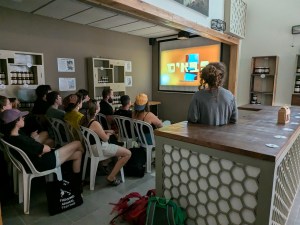
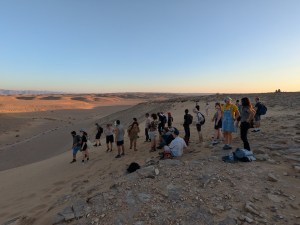
This course is part of a collegiate level sustainability and cooperative peace building program that brings together Israeli, Palestinian, Jordanian, and international students. Students take classes covering diverse aspects of sustainability, including ecology and conservation, sociology, and geopolitics.
In the first half of this course, students learn to define and identify pollination as a process and the ways which food security can be measured, recognize the diversity of pollinators and their behaviors, and understand the relationships between pollinators and food security. During the second half, students break down the relationship between pollinators and food security to understand the factors which impact this relationship, such as climate and land use change, the exposure of pollinators to poor nutrition, pests, and agrochemicals, and ultimately how these understandings can be transformed into policy solutions.
Pollination and food security syllabus
University of Wisconsin – Madison
Fall 2018: Exploring Biology (Integsci 100)
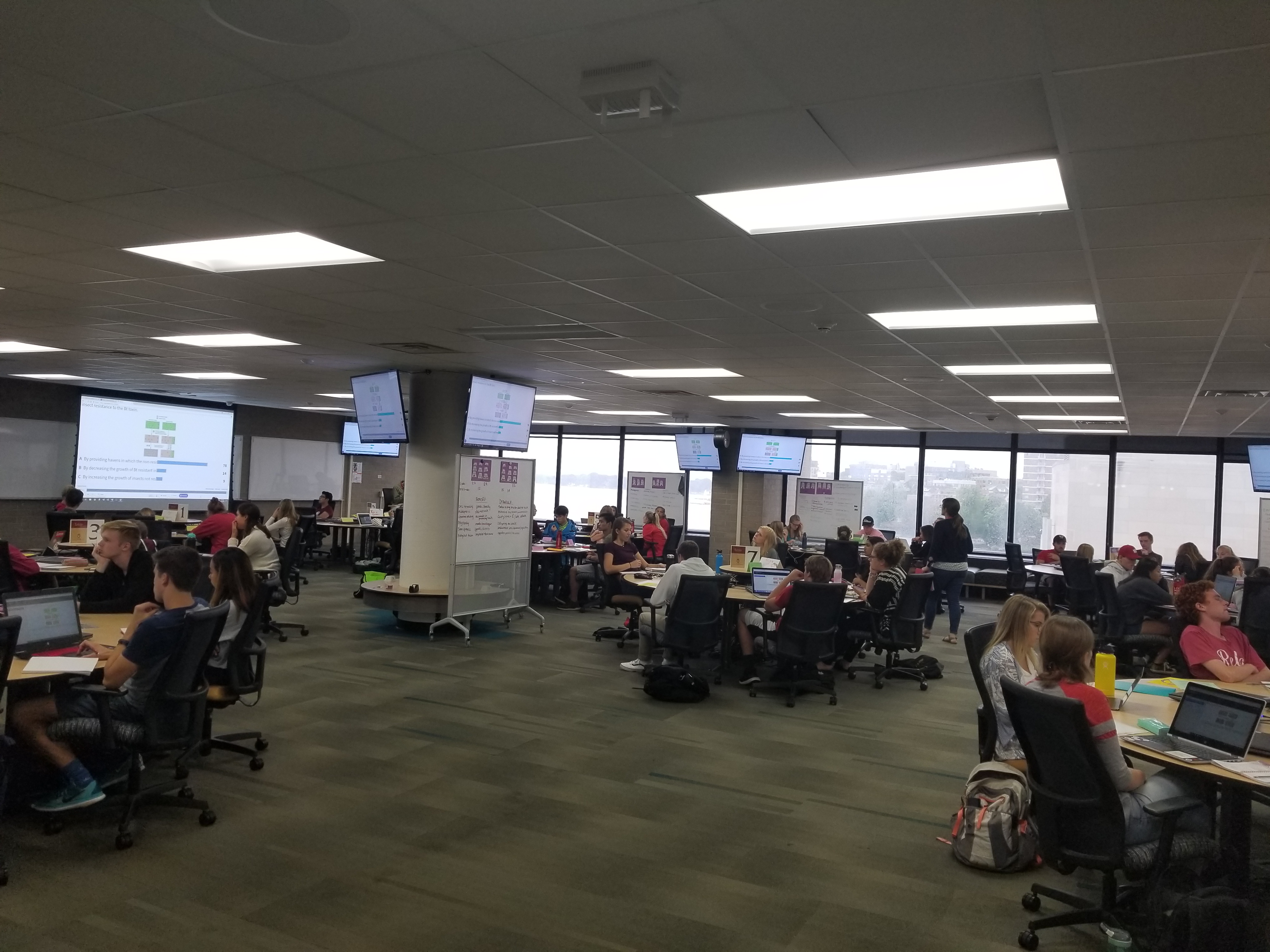
This course was co-developed and co-instructed as part of the WISCIENCE Teaching Fellows program. The course had over 100 students that formed groups of 5-6 at tables, and each table had computers, classroom monitors, and white boards. This type of classroom is considered a SCALE-UP (Student Centered Active Learning Environment with Upside-down Pedagogies) space. The purpose being to facilitate student interaction with each other, hands on activities, and problem solving. It is a truly unique experience that helps facilitate student engagement, and ultimately outcomes.
Summer 2018: Animal Biology (Zoology 100)
This is an introductory course for non-Biology major students. This course was taught during an 8-week summer session in lecture format and had 40 students. The students would split twice per week for more focused discussion sections where they would address more complex topics with critical thinking worksheets. Discussions were facilitated by the TA, and overall this course was a good collaborative effort.
Fall 2013-Spring 2018: Introductory Biology Lab and Case Study Teaching Assistant (TA) (Zoology 151/152)
Lab (151): Lab sections provide opportunities for students to engage in the process of science every step of the way, from literature searching and analysis, to data collection, and ultimately the communication of findings. Furthermore, in the second year of the sequence, in addition to inquiry-based labs, students engage in either a semester long mentored research or group meta-analysis project. Formative feedback is given at multiple times during the process, and ultimately students submit a completed write-up in the form of a scientific paper.
Case Study (152): These sections occur together with the lab sections described previously. However, they replace the traditional lecture with an inquiry-based active learning approach. Students work in small groups to solve six case studies throughout the semester. Each case study lasts 2-3 weeks, and students ultimately submit a 1-2 page summary to address a challenge posed in the case study. Students learn how to locate reputable information, and synthesize disparate sources to solve the real-life problem posed in each case study.
2008-2018 NOLS Field instructor
These are some of the early experiences that led Danny towards a career in teaching. These were expedition based leadership development courses. Typical courses were anywhere from 7 to 30 days in length in all seasons. These experiences brought Danny to some amazing places, and into contact with great students, instructors, and outdoor enthusiasts from around the world.
 Danny Minahan